Ancient Egyptian Gods: A Clear Guide to the Main Deities and What They Ruled

Ancient Egyptian gods are easier to tell apart once you sort them by what they governed. This guide covers twenty deities in groups: sky and creation, the afterlife, the divine family, protection, and the Nile and the land. Each entry gives the domain, the usual appearance, and the story or place attached to the god.
The main Egyptian gods at a glance
God | Domain | How to spot them |
|---|---|---|
Ra | Sun, kingship, creation | Falcon head with a sun disk and cobra |
Amun | Hidden power, king of the gods at Thebes | Man with two tall plumes, or a ram |
Shu | Air | Man with an ostrich feather on his head |
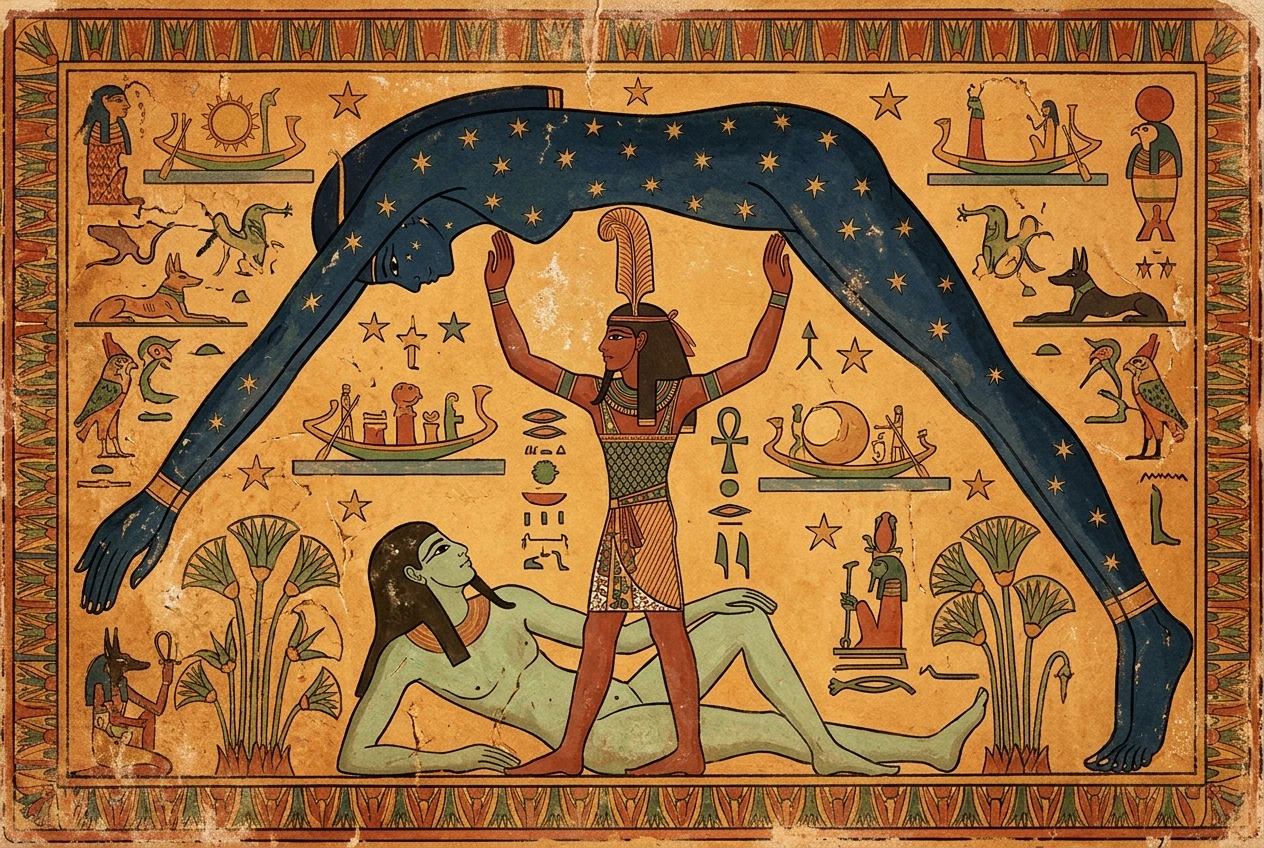
Nut | Sky | Woman arched over the earth, stars on her body |
Geb | Earth | Reclining man, often green or with plants |
Osiris | Afterlife, resurrection | Mummy-wrapped king, white crown, crook and flail |
Anubis | Embalming, guiding the dead | Jackal head or a black jackal |
Thoth | Writing, wisdom, the moon | Ibis head or baboon |
Ma’at | Truth, order, justice | Woman with an ostrich feather |
Isis | Magic, motherhood | Woman with a throne on her head |
Set | Storms, desert, chaos | Odd, long-snouted animal head |
Horus | Kingship, the sky | Falcon head, double crown |
Bastet | Protection of the home | Cat head or a cat |
Hathor | Love, music, joy | Cow ears or horns with a sun disk |
Bes | Household and childbirth | Bearded, dwarf-like figure, face forward |
Sekhmet | War, plague, healing | Lioness head |
Hapi | Nile flood | Plump figure with water plants on his head |
Sobek | Crocodiles, strength | Crocodile or crocodile head |
Ptah | Craftsmen, creation by speech | Mummy-wrapped man in a tight cap |
Khnum | Shaping humans, Nile source | Ram head, potter’s wheel |
Names and forms shifted over three thousand years, so treat the table as a starting point. The sections below explain how the gods connect.
Creation and the sky: Ra, Amun, Nut, Geb and Shu
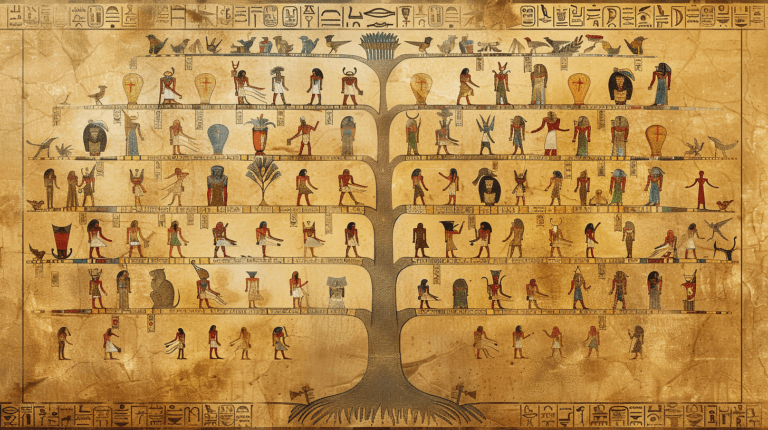
Egyptians told more than one story of how the world began, and each major city favoured its own. The best known comes from Heliopolis. In it a creator, Atum, emerges from the dark water of chaos and produces Shu (air) and Tefnut (moisture). Their children are Geb (earth) and Nut (sky), and their descendants include Osiris, Isis, Set and Nephthys. Together these nine form the Ennead.
Shu stands between the earth and sky. Pictures show him holding up Nut’s body, with a feather on his head. Nut is the sky arched over Geb, who lies beneath her. Tomb and coffin lids often show Nut’s body covered in stars, because the dead hoped to join her. In the myth, she swallows the sun each evening and gives birth to it at dawn.
Ra is the sun god and, in many texts, the king of the gods. He is usually shown with a falcon’s head crowned by a sun disk with a cobra coiled round it. By day he crosses the sky in a boat. At night he travels through the underworld, where the serpent Apep tries to stop him. Each sunrise therefore means a victory over chaos. His main cult centre was Heliopolis, and many pharaohs called themselves “son of Ra.”
Amun means “the hidden one.” He started as a modest god and became the national god of Egypt’s New Kingdom, centred on Thebes and the temple complex at Karnak. He is shown as a man with two tall plumes, or as a ram. His power grew so much that he merged with the sun god as Amun-Ra, a combination covered further down.
The afterlife and judgement: Osiris, Anubis, Thoth and Ma’at
For Egyptians, death was a journey with a trial at the end. Four gods dominate that process.
Osiris rules the dead. He is drawn as a king wrapped like a mummy, holding a crook and flail, and wearing the tall white atef crown. His skin is often green, a colour of new growth, because he stands for rebirth as well as death. His main cult centre was Abydos, and pilgrims left offerings there for centuries. Osiris was killed and revived in the myth, which is why the dead hoped to become “an Osiris” and live again.
Anubis is the jackal-headed god of embalming. He looks after mummification and guides souls through the underworld. Black, the colour of Nile silt and of the embalmed body, was his usual shade. Jackals prowled the desert edge where people were buried, which probably explains the animal.
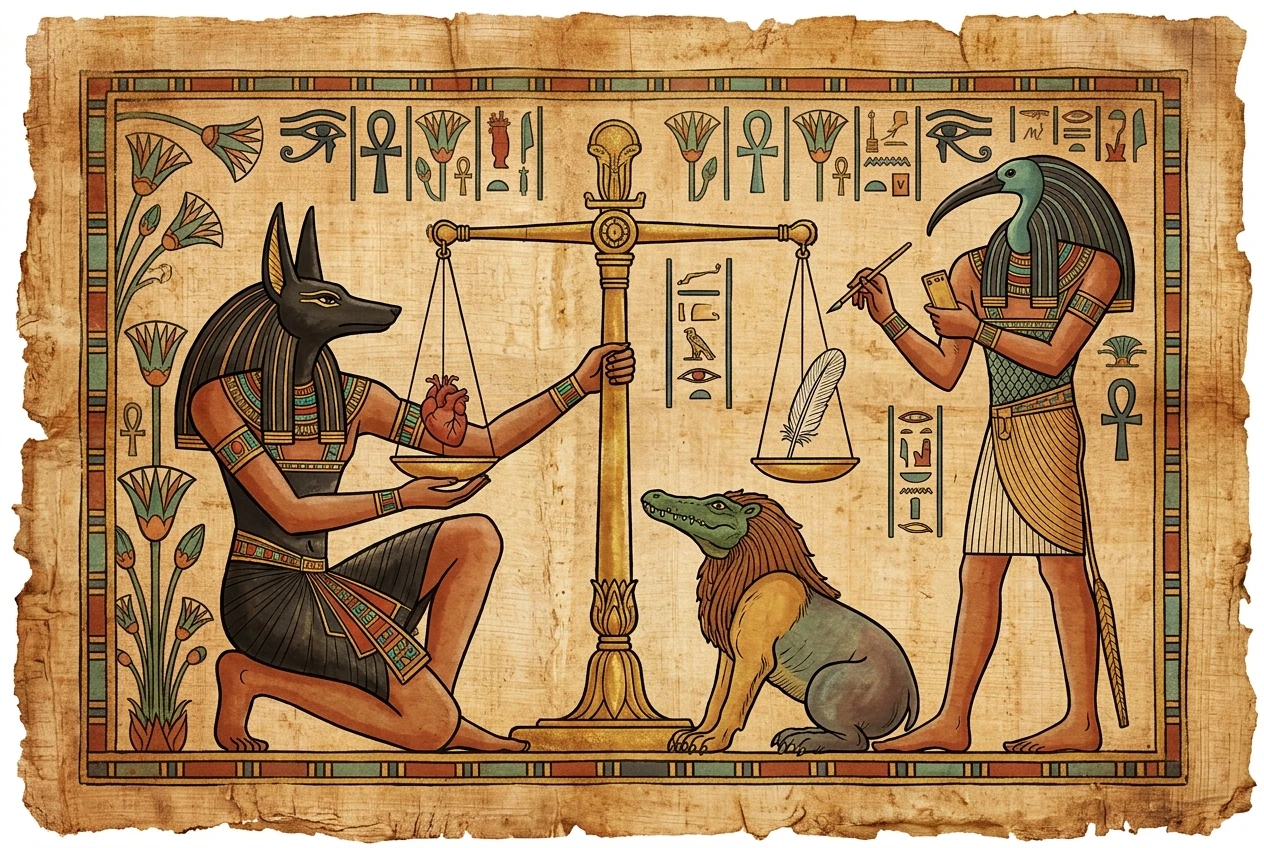
Ma’at is truth, justice and cosmic order, and also the goddess who personifies them. She wears an ostrich feather on her head, and the feather is her symbol. In the weighing of the heart, the dead person’s heart is weighed against her feather. If the heart is light, the person passes. If it is heavy with wrongdoing, the monster Ammit eats it.
Thoth is the scribe of the gods, shown with the head of an ibis, or as a baboon. He is lord of writing, counting and the calendar, and has a link to the moon. In the judgement scene he records the result of the weighing. His cult centre was Hermopolis, which the Egyptians called Khmun.
The divine family story: Isis, Osiris, Set and Horus
The myth of Osiris is the closest thing Egypt had to a central story. It is mostly known from fragments of texts and from a later Greek account by Plutarch, so details vary between sources.
Osiris rules Egypt well. His brother Set, god of storms, the desert and disorder, kills him and takes the throne. Isis, Osiris’s wife and sister, searches for his body and uses her magic to revive him long enough to conceive a son. That son is Horus. Isis raises him in hiding, and when he grows up he challenges Set for the kingship. After a long conflict, Horus wins, and Osiris becomes ruler of the dead.
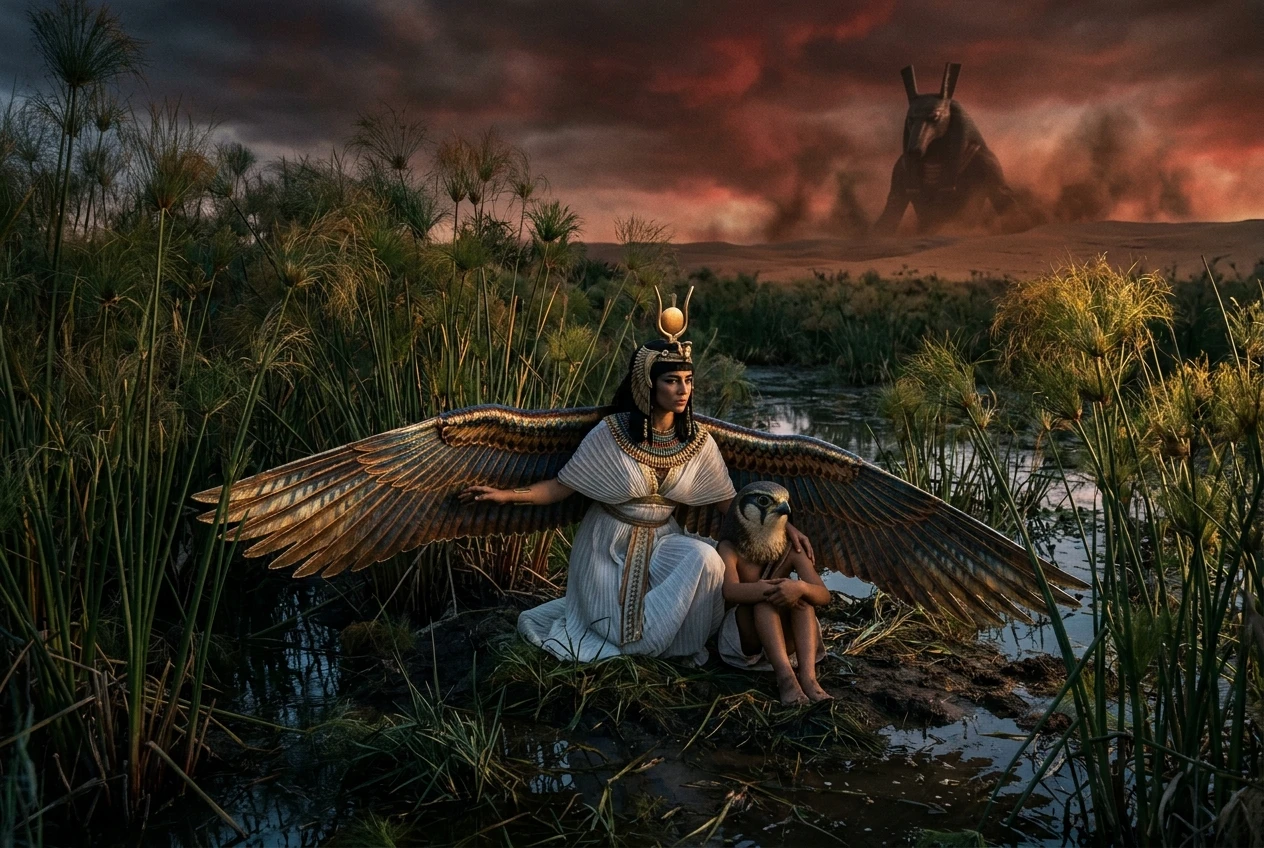
The story explains the royal system. The living king was Horus, and the dead king became Osiris. Each pharaoh’s succession repeated the victory of order over chaos.
How to tell them apart in art:
- Isis wears a throne-shaped hieroglyph on her head, or later a sun disk between cow horns. She often spreads winged arms to protect someone.
- Horus is a falcon or a falcon-headed man, often with the double crown of Upper and Lower Egypt. His eye, the wedjat or Eye of Horus, was a popular amulet for protection and health.
- Set has an animal head that no real creature matches, with a long curved snout and upright, squared ears. He was not purely evil. He also defended Ra’s boat against Apep.
Nephthys, sister of Isis and Set, usually appears alongside Isis in funeral scenes, mourning Osiris.
Protectors of home and people: Bastet, Hathor, Bes and Sekhmet
Many gods looked after everyday life. These four were close to ordinary households.
Bastet is a cat goddess whose main cult centre was Bubastis in the Delta. Early images show her as a lioness. Later she became the gentler cat-headed woman, often with a sistrum (a rattle) in her hand. She guarded the home, and cats were kept and mummified in her honour.
Hathor stands for love, music, dance, drunkenness and motherhood. She appears as a cow, or as a woman with cow ears or horns holding a sun disk. Her best-known temple is at Dendera. Egyptians also saw her as a goddess who welcomed the dead in the west.
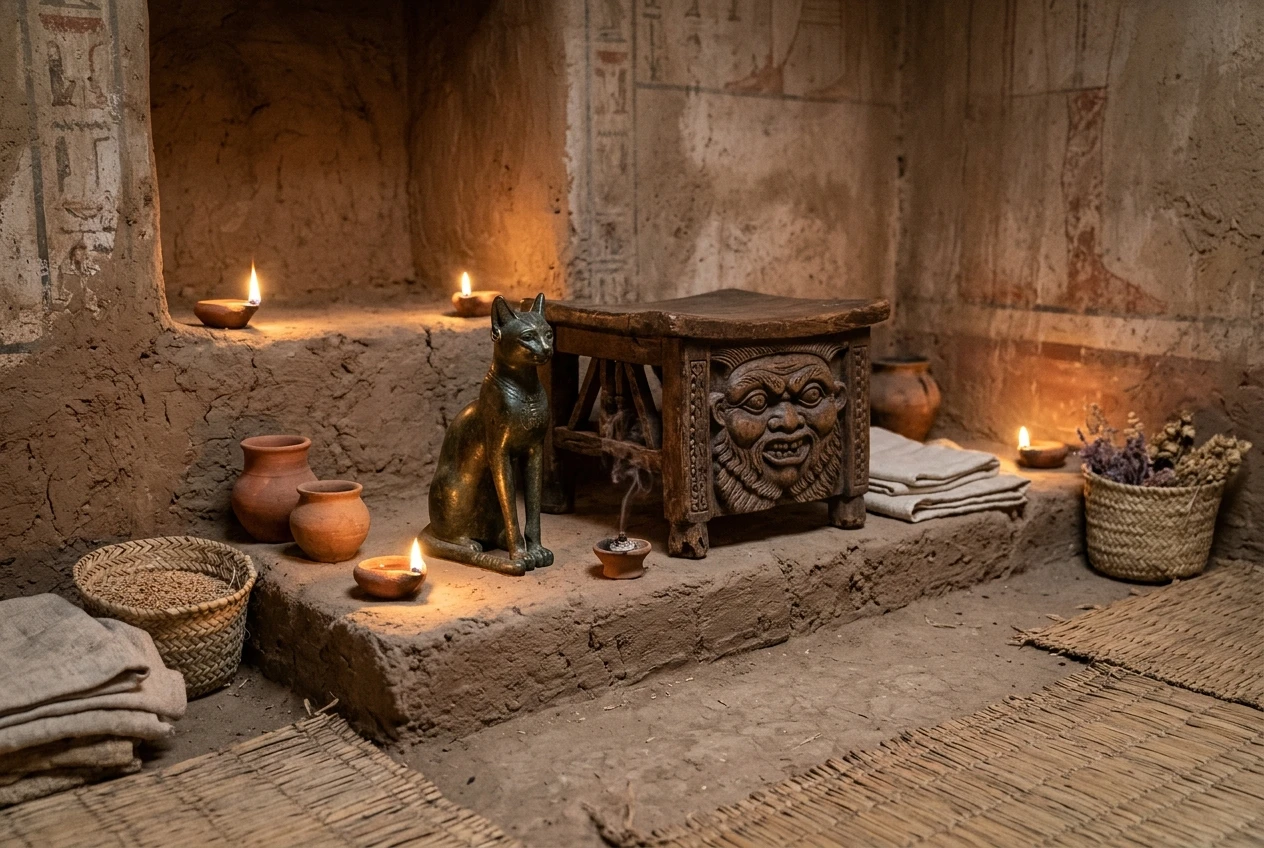
Bes looks different from nearly every other god: a short, bearded figure with a broad face that looks straight out at the viewer, often with his tongue out. His fierce look drove away evil, and he protected women in childbirth and young children. His image was carved on furniture, mirrors and amulets.
Sekhmet is a lioness-headed goddess of war and plague, who could also heal. A myth tells how Ra sent her as his Eye to punish humans who plotted against him. She began to slaughter them, and the gods stopped her only by flooding the land with beer dyed red, which she drank thinking it was blood. Priests of Sekhmet were often physicians. The same myth links her to Hathor, since both can be the Eye of Ra.
Gods of the Nile and the land: Hapi, Sobek, Ptah and Khnum
Egypt depended on the Nile’s yearly flood, and several gods are tied to it and to the land it fed.
Hapi is the spirit of the flood itself, not the river’s source. He is drawn with a round belly and heavy breasts, a sign of plenty, and with water plants on his head. He often brings offerings of food.
Sobek is the crocodile god. He is a double figure, dangerous but also a protector, and is linked to fertility and royal power. The Faiyum region and the temple at Kom Ombo were his main centres. Sobek can be shown as a full crocodile or as a man with a crocodile head.
Ptah is the god of Memphis and patron of craftsmen, sculptors and builders. In the Memphite account of creation, he brings the world into being by thinking it in his heart and speaking it. He is shown as a mummy-like man with a tight cap, holding a staff that combines three symbols (life, power and stability).
Khnum is a ram-headed god who shaped people and their life force (the ka) on a potter’s wheel. His chief centre was Elephantine, near the first cataract at Aswan. Egyptians associated that area with the source of the Nile flood, so Khnum was believed to control the water as well.
Why gods have many faces
A newcomer is often confused to find one god with two names or two heads. Three habits explain most of it.
Animal heads show qualities. Egyptians did not think their gods were animals. A falcon suggested sharp sight and height, a jackal the desert’s edge and cemeteries, a lioness fierce protection. A god could be shown in several animal forms or in human form depending on context.
Gods merged. Egyptians combined names when two gods shared roles. Amun-Ra joined the hidden king of Thebes with the sun. Ra-Horakhty joined Ra with Horus of the horizon. Ptah-Sokar-Osiris combined Memphis’s creator with a god of the Memphis cemetery and the lord of the dead. Merging did not cancel either god. It added the power of one to the other.
Importance changed over time. The god of the ruling city or dynasty often rose with it. Ra was prominent in the Old Kingdom, Amun in the New Kingdom, and Osiris became popular with ordinary people over time. Local gods also stayed strong in their home towns. A single “Egyptian religion” is a modern simplification of a belief system that grew for three thousand years.
Skin colour was symbolic too. Green meant growth and rebirth, black meant fertile soil, and gold or yellow meant the imperishable flesh of gods.
How to recognise a god in a tomb painting or temple relief
Start with the caption. Hieroglyphs beside the figure usually give the name. If you cannot read them, use a short checklist:
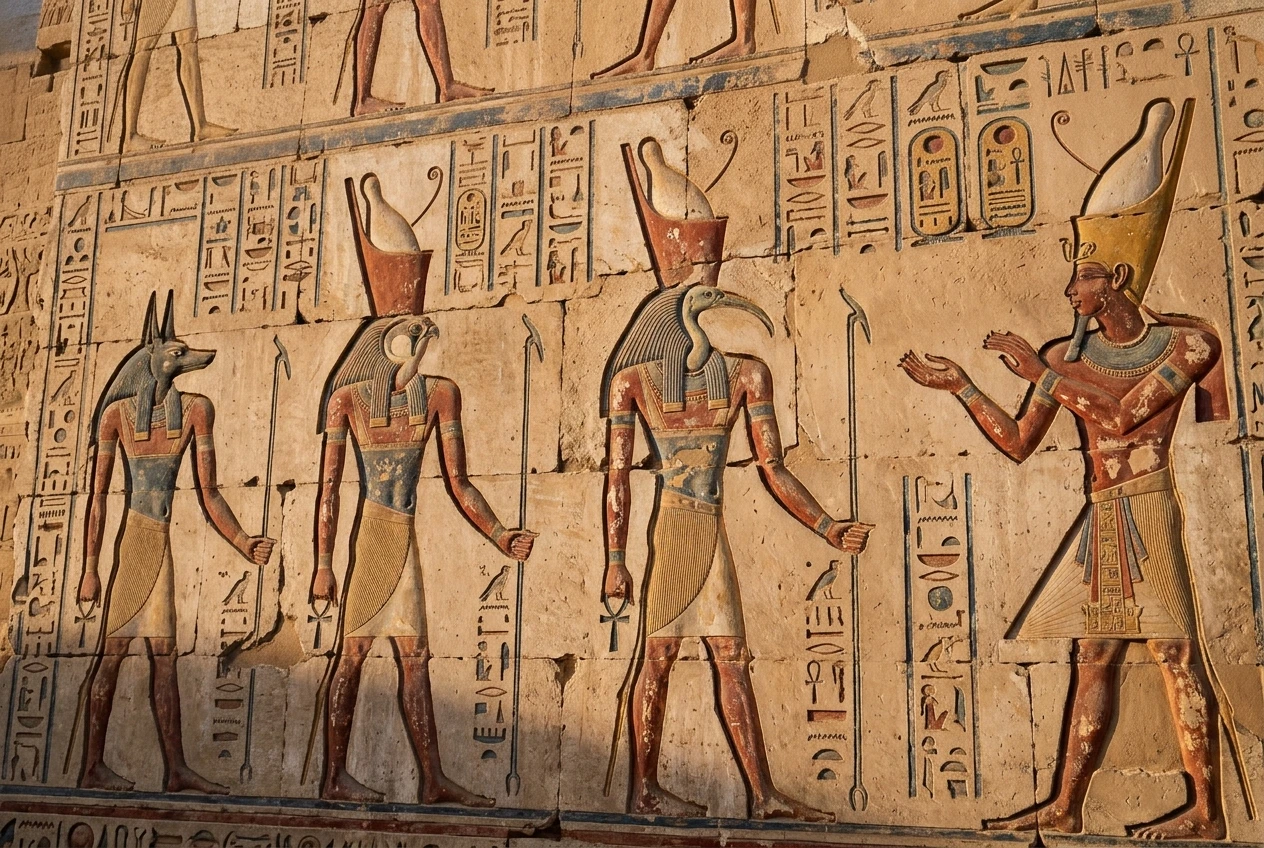
- Look at the head. A falcon, jackal, ibis, ram, cat, lioness, crocodile or cow ears narrow the list at once.
- Look at what is on the head. A sun disk suggests Ra or a solar god, a feather points to Shu or Ma’at, a throne to Isis, and the tall white crown to Osiris.
- Look at what they hold. Gods usually carry the ankh (life) and a was sceptre (power). Goddesses often hold a papyrus-shaped staff. Osiris holds the crook and flail.
- Look at the pose. Mummy-wrapped, with the arms crossed or hands emerging at the front, means Osiris or Ptah. A body arched over the scene means Nut. A figure face-on among profile figures is likely Bes.
- Look at the scene. A weighing of the heart will show Anubis, Thoth and Ma’at. A boat with a sun disk will show Ra. A figure bringing offerings with water plants is Hapi.
Most gods are shown in profile, in the flat style of Egyptian art, with both feet planted on the ground. Their size can show rank, and the pharaoh is often shown being embraced or crowned by a god. Once you know the main heads and crowns, scenes in temples such as Karnak, Dendera and Philae become much easier to read.
Ancient Egyptian gods: frequently asked questions
Who is the most important Egyptian god?
It depends on the period and the place. Ra was prominent in the Old Kingdom, Amun rose to be the national god of the New Kingdom, and Osiris grew popular with ordinary people because he promised life after death.
How many gods did ancient Egypt have?
Nobody can give a firm number. Egyptians worshipped hundreds of gods, and many towns had their own local deity alongside the national ones. This guide covers twenty of the ones a newcomer meets first.
Did Egyptians think their gods were animals?
No. Animal heads show qualities: a falcon suggests sharp sight and height, a jackal the desert edge and cemeteries, a lioness fierce protection. The same god could appear in human or animal form depending on context.
Why do some gods have two names, like Amun-Ra?
Egyptians merged gods who shared roles. Amun-Ra joined the hidden king of Thebes with the sun god. Merging did not cancel either god. It added the power of one to the other.
Which gods were linked to the afterlife?
Osiris rules the dead, Anubis guides souls and looks after embalming, Thoth records the verdict, and Ma’at’s feather is the weight against which the heart is judged.
Which gods protected ordinary homes?
Bastet guarded the household, Bes drove away evil and protected women in childbirth and young children, and Hathor stood for love, music and motherhood.
How can I tell the gods apart in a temple or tomb?
Look at the head, what is on the head, what the figure holds, the pose and the scene. The checklist in the section above walks through each one.